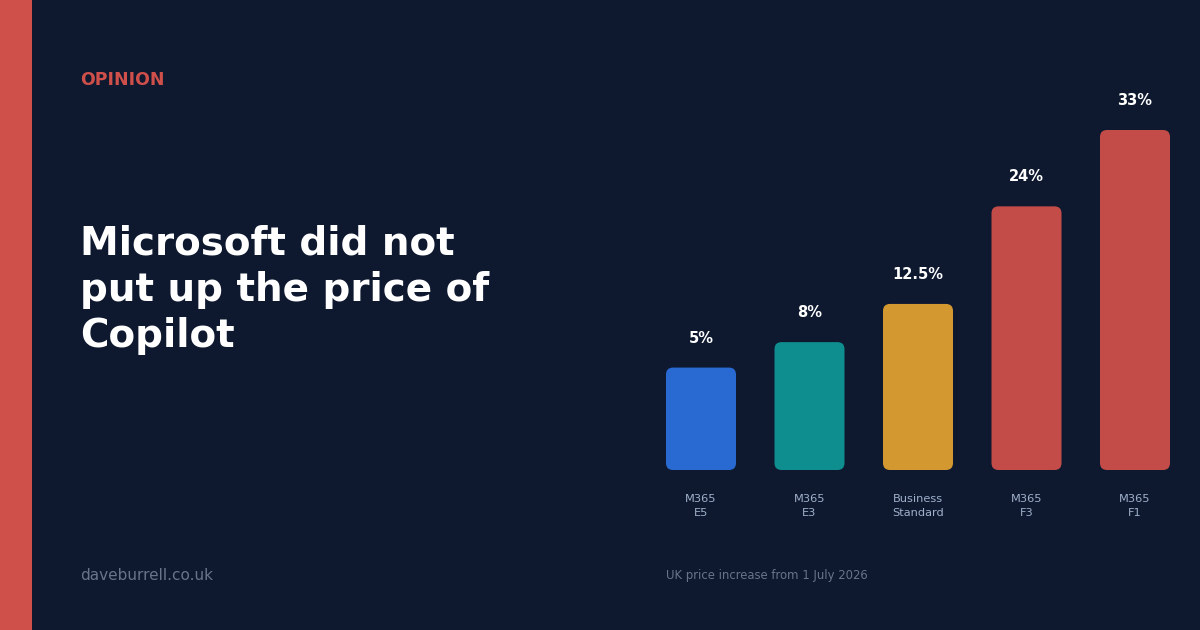

The add-on costs the same as it did last month. Everything underneath it went up, and the AI still appeared on your bill anyway.
Since 1 July, the headlines have been fairly consistent: Microsoft has raised the price of AI. It is an easy story to write,e and it is wrong in an interesting way.
Microsoft 365 Copilot costs what it cost in June. Microsoft’s own licensing note says it plainly: standalone Teams and Copilot SKUs are not part of the update. What went up is the price of the thing Copilot runs on.
What actually changed
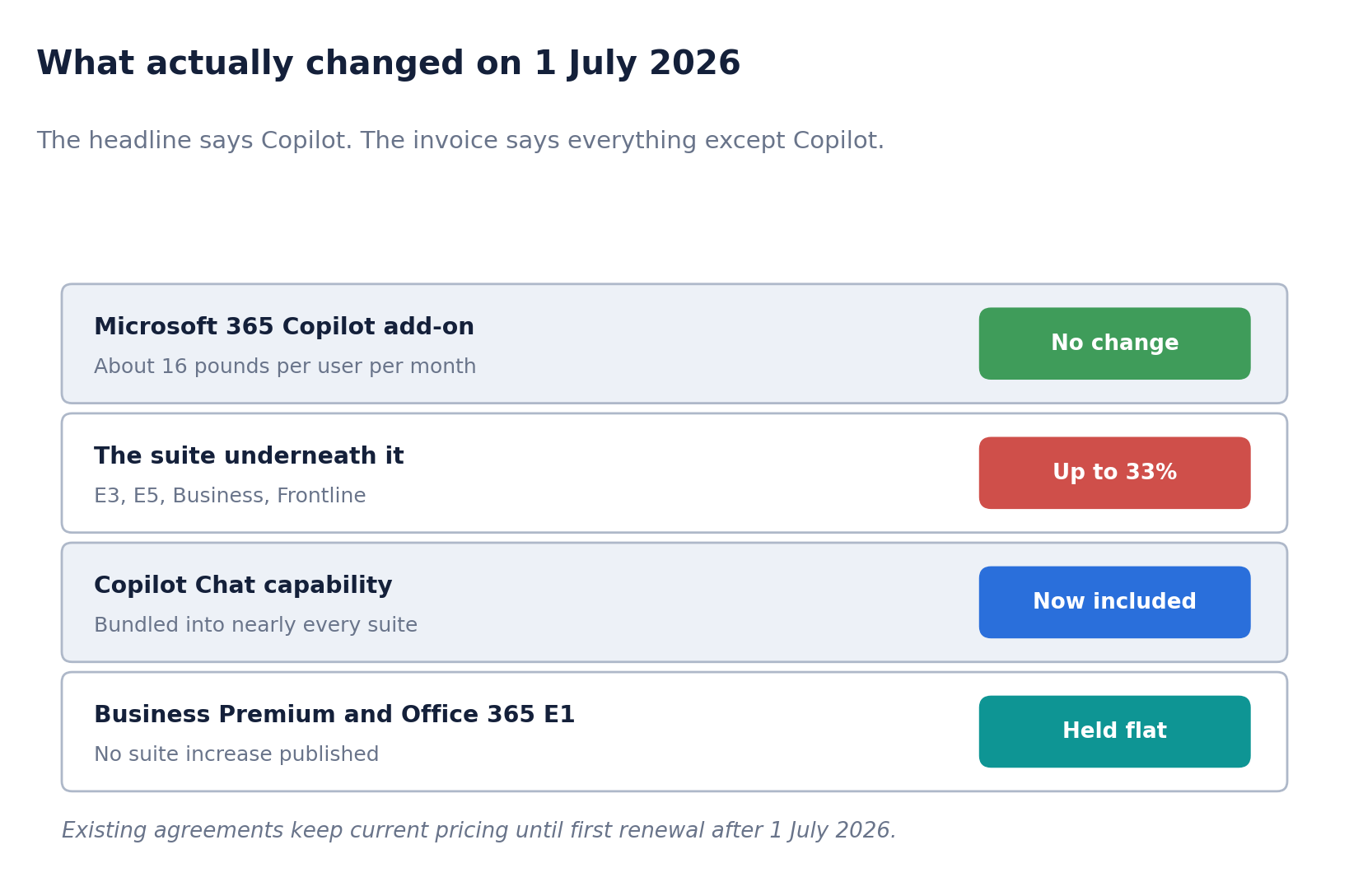
In UK terms, on annual subscriptions paid yearly and excluding VAT, Office 365 E3 went from £247.20 to £279.60 a year. Microsoft 365 E3 from £372 to £402. E5 from £588 to £619.20. Business Standard from £115.20 to £129.60. If you are paying for Copilot on top at around £16 per user per month, your all-in cost per seat rose even though the Copilot line did not move.
Alongside the price change, Microsoft added capability to almost every suite. Some of it is genuinely valuable: Defender for Office Plan 1, several Intune components, Security Copilot for E5 customers. And on every single suite in the table, including the cheapest frontline plans, two more entries: Copilot Chat enhancements and Copilot Chat Analytics.
Microsoft did not raise the price of AI. It moved AI into the base product and raised the price of that instead.
Those enhancements are specific rather than cosmetic. Inbox and calendar awareness, and access to the Word, Excel and PowerPoint agents. That is a real step up from a chat box that could only see the open document, and it now lands on seats that were never going to buy a Copilot licence.
The bit I find hard to defend
Look at how the increase is distributed, and something uncomfortable appears.
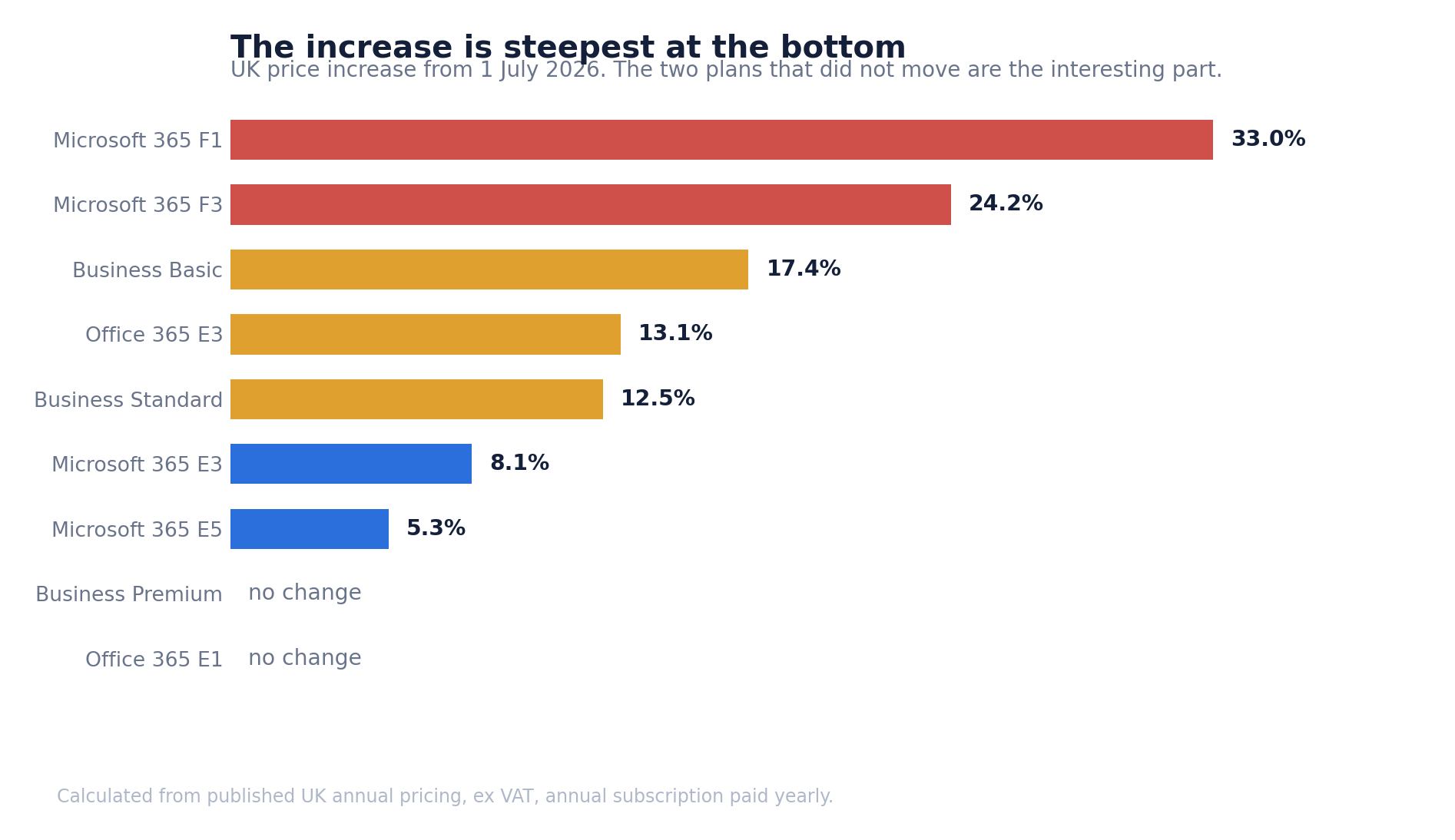
Microsoft 365 E5, the most expensive seat, rises 5.3%. Microsoft 365 F1, the cheapest, rises 33%. Frontline F3 rises 24%. The steepest increases land on the plans bought for shop floor staff, ward staff, drivers and retail workers.
The defence is arithmetic, and it is not a bad one. A 33% rise on F1 is £6.84 a year, or 57 pence a month. A 5.3% rise on E5 is £31.20 a year. In absolute cash, the enterprise seat still absorbs more, and the frontline plans were priced very low to begin with.
The problem is what the frontline seat gets for its 33%. Scan the packaging table, and F1 and F3 receive exactly two additions: Copilot Chat enhancements and Copilot Chat Analytics: no Defender, no Intune tier, no Security Copilot. So the plans with the largest percentage increase are the ones whose entire justification is AI chat, aimed at the population least able to use inbox and calendar reasoning, because a large share of frontline workers do not sit at a desk with an inbox and a calendar.
An NHS trust or a retailer with 8,000 frontline staff on F3 is looking at an additional £144,000 a year in cost, for capability the packaging table tells you is essentially Copilot Chat. That is a real budget conversation, and “the percentage looks worse than it is” will not survive it.
For the practitioners
- Your exposure date is your first renewal after 1 July 2026, not 1 July itself. Find it before you model anything.
- UK percentages differ slightly from the headline US figures. Business Basic is 17.4% here, compared to 16% in the US price list; F3 is 24.2%, compared to 25%. Model from UK figures, not converted to dollars.
- The no-Teams variants took larger percentage increases across the board. If you moved to them for EU competition reasons, recheck the maths, because the gap has narrowed.
- Packaging rolls out from June 2026, with at least 30 days’ notice in the Message Centre, and is completed by 1 August. Capability may land in your tenant before you have decided how to govern it.
- Copilot Chat with inbox and calendar awareness is a data governance event, not just a feature. It reachesusers’ mail and calendar, even if they were never in scope for a Copilot rollout, so your oversharing and labelling work now covers a wider population.
- Government pricing is phased over multiple years, with increases exceeding 10%, and nonprofit pricing tracks commercial through a fixed discount of 60% to 75%.
The number nobody is talking about
The most useful thing in the announcement is not a price that rose. It is two that did not.
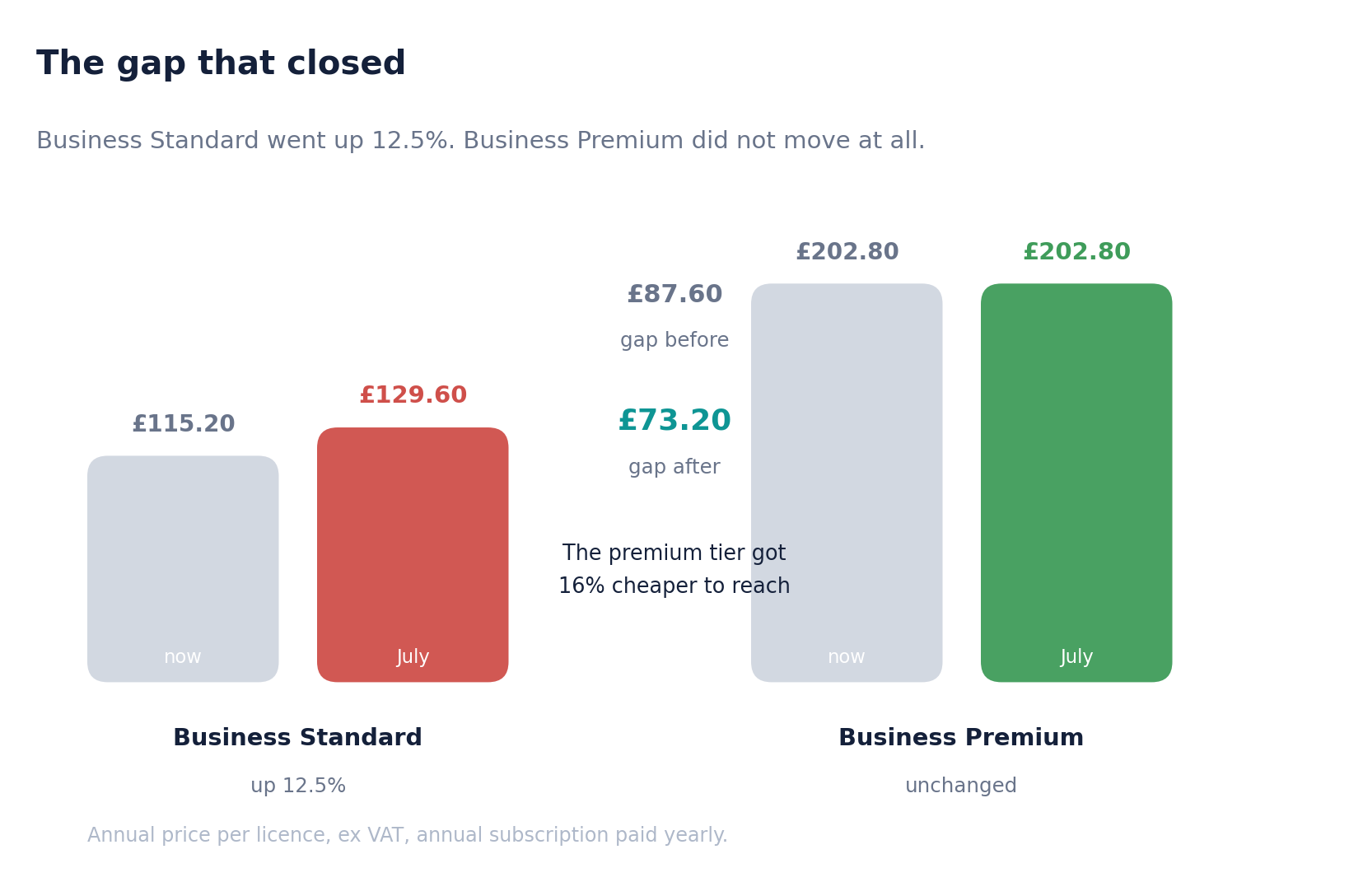
Microsoft 365 Business Premium is not listed as receiving a suite increase. Neither is Office 365 E1. Business Standard rose 12.5%, and Business Basic rose 17.4%, so the gap between the mid-tier and the top-tier of the small-business range has quietly closed.
Before July, moving a user from Business Standard to Business Premium cost an extra £87.60 a year. It now costs £73.20. The premium tier is 16% cheaper to reach without its own price moving a penny, and it includes the security and device management that Business Standard does not: Intune, Defender for Business, conditional access, and Entra ID Plan 1.
For a 20-person business, the Business Standard increase is £288 a year. Spending that on the upgrade path instead of absorbing it is a better conversation than most licensing conversations you will have this year. I would not usually recommend spending more in response to a price rise, but this is the rare case where the alternative is paying more for the same thing.
What I think is actually going on.
Two years ago the pitch was that Copilot was a premium add-on you evaluated, piloted and justified. Sixteen pounds a seat was a decision, and plenty of organisations decided no.
That model has quietly ended. Copilot Chat is now in the base product for practically everyone, the capability gap between free and paid has narrowed at the bottom, and the paid tier is being repositioned as the serious version rather than the only version. Microsoft has stopped asking whether you want AI and started asking how much of it you want.
Strategically, this is sound, and I would probably do the same. Adoption was the binding constraint, not price, and the fastest way to fix an adoption problem is to stop making people opt in. It also resolves the awkward question of what Copilot Chat was for, by making it the on-ramp rather than a consolation prize.
What I object to is the framing. This is presented as continuous innovation, with the added capability justifying the increase. For E3 and E5 customers gaining Defender and Intune components, that is a fair description. For an F1 seat gaining Copilot Chat Analytics and paying a third more, the word innovation is carrying an enormous amount of weight.
What to do about it
- Find your renewal date and model the increase against it. The July date is a distraction if you renew in March.
- Audit your frontline seats specifically. That is where the percentage bites hardest and where the added capability is thinnest, so it is where a plan change or a seat count reduction is most likely to pay.
- If you are on Business Standard, price the move to Business Premium properly. The gap has closed by 16%, and the security difference is substantial.
- Check whether an annual commitment paid yearly beats your current billing model. It is the lowest published per-user route and plenty of organisations are on something more expensive by default.
- Treat Copilot Chat reaching mail and calendar as a scope change to your data governance work, and check your oversharing position for the population it newly covers.
- Please decide deliberately whether the newly bundled capability is something you will use, because you are paying for it either way, and ignoring it is the most expensive option available.
What to take away
- The Copilot add-on price did not change. The suites underneath it rose by up to 33% in the UK.
- Copilot Chat is now bundled into nearly every suite, including frontline plans. That is the real story.
- The increase is steepest on the cheapest plans, and those plans receive the least added capability.
- Business Premium and Office 365 E1 did not rise, so the upgrade path from Business Standard just got 16% cheaper.
- Your exposure date is your first renewal after 1 July 2026, not 1 July itself.
