
The tooling question gets settled in a quarter. The harder change is what managers do all day, and that one takes years.
Nine posts in this series have been about specific topics: use cases, data, platforms, agents, controls, and measurement. This one is about the change beneath all of them, which is slower, less tractable, and ultimately determines how much of the rest matters.
Organisations are structured around the assumption that work is done by people, in teams, reporting to managers who allocate it. Every part of that sentence is under mild pressure right now.
Four ways of working with AI
Microsoft’s 2026 Work Trend Index describes a progression through four patterns, and it is the most useful framework I have seen for this, mainly because it focuses on what the person does rather than what the technology does.
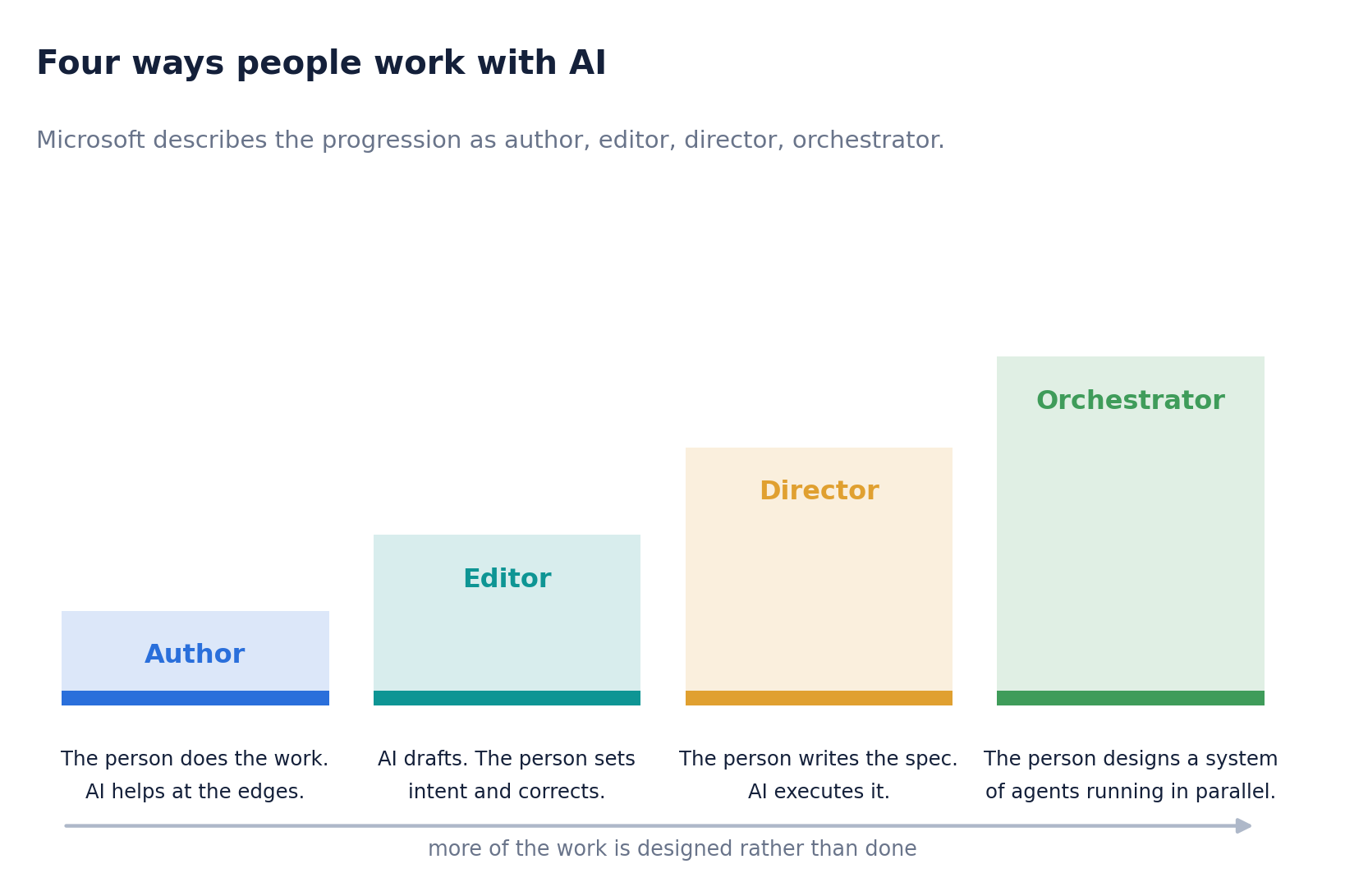
The interesting part is not that the fourth mode exists. It is how few people reach it. Microsoft found that only 16% of AI users qualify as what they call Frontier Professionals, suggesting progression is not something that happens to people through exposure. It requires deliberate design.
Which makes sense when you look at what changes between the modes. Author-to-editor is a skill shift, and most people manage it within weeks. Editor to director is different: it requires the ability to specify work precisely enough for someone else to execute it, which is a genuinely difficult skill that many experienced professionals have never needed to develop. They are good at doing the work, not at describing it.
What this does to management
If a growing share of work is specified rather than performed, then the bottleneck moves from capacity to clarity, and management shifts accordingly.
- Reviewing output matters more than allocating tasks. When drafting is cheap, the scarce activity is judging whether a draft is any good.
- Specification becomes a core skill rather than a documentation chore, yet it is unevenly distributed in ways that do not neatly correlate with seniority.
- Quality control moves earlier. Checking a hundred agent outputs after the fact does not scale. Designing the constraint so the outputs are right does.
- The junior work that used to build expertise is exactly the work that automates first, which creates a real and unresolved problem about how people develop judgement.
That last one deserves more attention than it gets. The traditional path in most professions runs through doing a lot of routine work badly, then adequately, then well, and acquiring judgement along the way. If the routine tier disappears, the pipeline that produced senior people disappears with it. I do not think anyone has a good answer to this yet, and I am suspicious of people who claim they do.
Why culture beats enthusiasm
The finding from the Work Trend Index that organisational factors drive roughly twice the impact of individual mindset has a direct implication for how you spend the transformation budget.
An engaged individual in an organisation that has not changed its expectations sees their personal productivity go nowhere. They finish early and pick up more of the same work. Nothing at the system level moves.
Change the expectations, and even moderately engaged people produce a shift, because the work itself has been redesigned around the new capability. The order matters: redesign the work, then the adoption follows. Attempting it the other way round is the most common and most expensive sequencing error in this whole field.
For the practitioners
- Microsoft reported that active agents in the Microsoft 365 ecosystem grew roughly 15-fold year on year, rising to 18-fold in large enterprises. Plan the operating model for the volume you will have in eighteen months, not the volume you have today.
- Analysis of over 100,000 Copilot conversations found that 49% supported cognitive work, such as analysis and evaluation, rather than pure content generation. If your enablement focuses on drafting, you are teaching the least valuable half.
- Orchestration is a real job that currently has no home. Someone has to design how agents hand off to each other and to people. Decide whether that sits with IT, with process owners, or somewhere new, before it defaults to nobody.
- Build the evaluation habit before you build the agent estate. A team that already reviews outputs systematically scales to many agents. A team that does not will discover the problem at around agent number fifteen.
What I would actually do
If I were advising a leadership team starting this year, the sequence would be unglamorous and roughly this.
Fix the data and permissions first, because everything downstream is gated on them and they take the longest. Pick three use cases with real owners and measure them properly. Get the governance layer configured while the estate is small enough that it is a configuration exercise rather than a programme. And spend the change budget on managers rather than on awareness campaigns, because managers are where the organisational half of the effect lives.
None of that is a strategy in the sense that a consultancy would present one. It is closer to a sequence of unremarkable decisions taken in the right order. But the evidence across the last two years suggests that unremarkable decisions in the right order beat ambitious ones in the wrong order by a very wide margin, and that is not a conclusion I expected to reach when I started paying attention to this.
What has to stop
Transformation programmes are almost always additive: new roles, new forums, new capabilities, new training. Very little gets removed, which is why the organisation ends up carrying both the old and new operating models at the same time and wonders why it feels heavier rather than faster.
A few things are worth explicitly retiring.
- Process documentation that describes how work was done before, still being maintained by someone, still being used to onboard new starters into a method that no longer applies.
- Quality checks that were designed for human error patterns. AI fails differently, and a checklist tuned to catch typing mistakes will not catch a confidently wrong citation.
- Approval steps that existed because the work was slow. If a document now takes two hours instead of two days, a three-day approval window is the bottleneck rather than the safeguard it was designed to be.
- Reporting that measures effort. Hours logged and volumes processed stop meaning what they used to mean once a meaningful share of the volume is produced by something that does not get tired.
This is genuinely difficult work, and it is why so few organisations do it. Removing a control requires someone to accept responsibility for the risk of removing it, and that is a much less comfortable position than adding one.
The two-year view
I want to be careful here because confident predictions about AI have a poor track record, and the honest position is that nobody knows how much of the current trajectory will continue.
What seems reasonably safe: the volume of agents in a typical tenant keeps rising, the governance question stops being optional, and the organisations that did the data work early keep pulling ahead of the ones that did not, because that gap compounds rather than closes. What seems much less certain: how far the director and orchestrator modes actually spread, whether the current cost structures hold, and whether the productivity gains show up in aggregate economic data at all. Reasonable, well-informed people disagree sharply on all three, and I would treat anyone who does not acknowledge that as selling something.
Which leads to a practical conclusion. Build for the parts you are confident about, which are mostly the unglamorous foundations, and stay deliberately flexible on the parts you are not. An organisation with clean permissions, a governed agent estate and a measurement habit is well placed under almost any version of the next two years. An organisation that bets heavily on a specific vision of how work will be organised is only well-placed if that vision turns out to be right.
What to take away
- Most people plateau at editor. Reaching director and orchestrator requires deliberate design, not exposure.
- Specification is becoming a core professional skill, but it is not evenly distributed across seniority levels.
- Redesign the work first. Adoption follows changed expectations, not the other way round.
- The disappearance of routine junior work is a genuine unsolved problem for developing judgement. Be sceptical of confident answers.
- Spend the change budget on managers. That is where the organisational half of the effect sits.
